Physical Address
304 North Cardinal St.
Dorchester Center, MA 02124
Physical Address
304 North Cardinal St.
Dorchester Center, MA 02124

You think about cutting your hair, and Instagram starts showing short-hair transformations.
You quietly wonder whether your partner is losing interest, and TikTok fills your feed with videos about emotional distance.
You discuss an unusual holiday destination with a friend. Ten minutes later, an advertisement for the same place appears.
You did not type it. You may not have searched for it. Sometimes, you did not even say it aloud.
So how did your phone know?
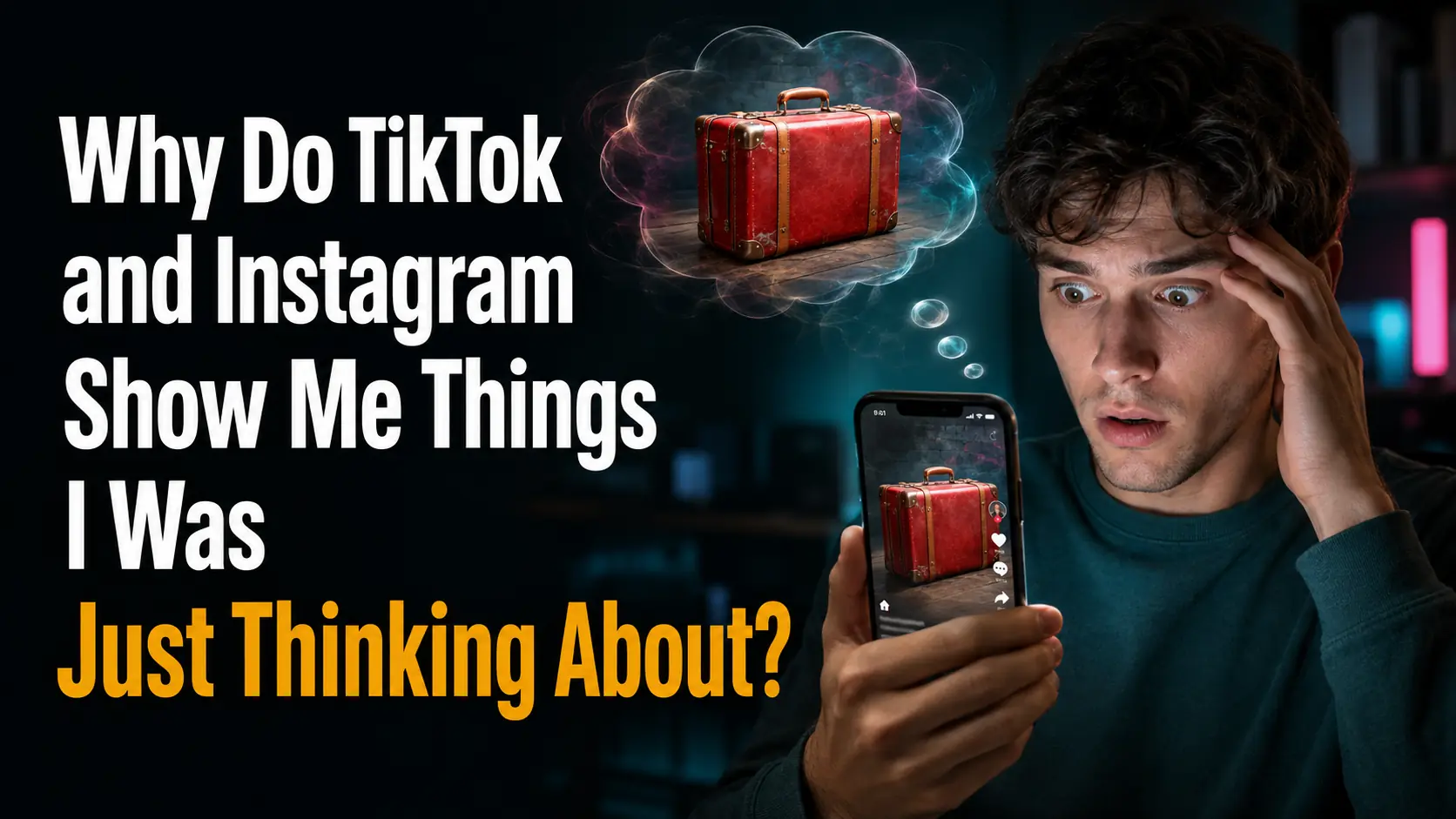
TikTok and Instagram cannot literally see a private thought. However, they can collect small behavioural signals, connect activity from different services, compare you with similar users and predict what may interest you next. Sometimes they may also have shown you the idea earlier without you consciously remembering it.
When the recommendation follows a spoken conversation, many people suspect microphone access. That suspicion is understandable, although continuous secret listening for recommendations has not been publicly proved.
The uncomfortable truth may be bigger than microphone listening: these platforms do not always need to hear your conversation. Your behaviour can reveal where your mind is going before you realise it yourself.
Not every strange recommendation has the same explanation. Ask which of these happened:
A sponsored advertisement may use information received from businesses, shopping websites or other apps. A normal Reel is more likely to be connected to watch time, topics, sounds, people you follow and the behaviour of users similar to you.
The two systems can overlap, but they are not identical.
This is why “Instagram read my mind” can describe several very different events.
Many people report a remarkably similar experience.
They discuss a product, illness, relationship concern or travel destination near their phone. They do not search for it. Soon afterward, TikTok or Instagram shows them related videos or advertisements.
Because both apps may already have microphone permission, people naturally wonder whether the conversation was recorded.
TikTok and Instagram can use the microphone for genuine app features, including:
Microphone permission makes audio access technically possible when an authorised feature is being used. However, there is no clear public proof that TikTok or Instagram continuously records ordinary private conversations to decide which videos or ads to show.
That does not mean people imagined the timing.
A conversation may be followed by related content because:
We cannot prove what caused one individual recommendation. But if you mention something highly unusual and see it five minutes later, it is reasonable that microphone access becomes your first suspicion.
You can check this more carefully by removing microphone permission for a week and reviewing the microphone indicators or privacy dashboard on your phone. A single matching video will not prove anything, but a written record may help you separate repeated patterns from memorable coincidences.
There is an important difference between suspected background listening and intentionally speaking to an AI feature.
Meta has said that interactions with Meta AI, including voice conversations, may be used to personalise content and advertisements across eligible connected Meta accounts.
If you ask Meta AI about hiking routes, home workouts or places to visit in Japan, you may later see related Instagram Reels or advertisements.
In that situation, something you said really can influence what appears on Instagram.
But this is not the same as Instagram secretly recording a private conversation between you and another person. You directly gave the information to an AI service connected to the platform.
As social media apps add more AI features, the boundary may become less obvious. A person may think they are having a temporary conversation with an assistant without realising that it could become another personalisation signal.
You do not need to press the like button to show interest.
TikTok and Instagram can learn from behaviour that feels too small to matter:
Suppose you see a video about a woman leaving an unhappy marriage. You do not like it because you do not want anyone to see that you engaged with it. But you watch the entire video and read the comments for three minutes.
To the recommendation system, that may be a much stronger signal than a casual like.
You may forget the video by the next morning. The platform does not.
Short videos are particularly effective at collecting these reactions because they create hundreds of small decisions in a single session. Every pause, skip and replay helps the system test another prediction. This is part of how short videos can affect attention span while also giving platforms a detailed map of what holds your mind.
Imagine that thousands of people watch videos about job stress, Sunday anxiety and difficult managers. Many of those people later begin watching videos about quitting, freelancing or moving abroad.
If you follow the same early pattern, TikTok does not need to wait for you to search “Should I quit my job?”
It can begin testing that next subject on you.
Similar patterns may include:
The platform does not need to understand you as a complete person. It only needs to notice that your recent behaviour resembles a path followed by many other users.
This can make prediction feel like mind-reading.
The thought seems deeply personal when experienced from inside your own mind. From the platform’s view, however, it may be a common next step within a large behavioural pattern.
Not every video on your feed is based on an interest the platform already knows about.
TikTok and Instagram must occasionally show you unfamiliar topics. Otherwise, your feed would become repetitive, and the platforms would never discover new interests that might keep you watching.
Most of these test videos fail.
You scroll past a gardening video, a celebrity interview, a parenting joke and a recipe without thinking about them again. When the platform tests a video that matches a thought you had that morning, the experience feels completely different.
You remember that one.
TikTok may not have known you were thinking about the subject. It may have tested the video on thousands of people, and you happened to be the person for whom it felt strangely accurate.
What happens next is more important.
You pause because the match surprises you. You read the comments to see whether other people had the same experience. You watch another related video. The system reads this attention as interest and begins showing more.
One coincidence can therefore become an entire feed within hours.
This is also why investigating a frightening recommendation inside the app can make it worse. Every minute spent trying to understand the video teaches the system to send you more of the same.
A sponsored advertisement can use signals that did not begin on TikTok or Instagram.
A business may share information about actions such as:
Advertisers can also use customer lists and audience groups to reach people who resemble existing buyers.
You may visit a shoe website without being logged in to Instagram. Later, Instagram shows you the same shoes. From your perspective, the two activities feel separate. Inside the advertising system, they may be connected through browser information, device signals, accounts or data supplied by the business.
The US Federal Trade Commission found that major social media and video platforms collected large amounts of information through user activity, advertising technologies, data brokers and algorithmic inferences. Its report on social media surveillance shows why microphone listening is not required to produce highly personal targeting.
Proven tracking can already feel supernatural.
Possibly, but not because Instagram necessarily gives you a direct copy of another person’s search history.
People living together may share several signals:
Suppose you and your partner discuss buying a coffee machine. Your partner searches for one later that evening. You then see a coffee-machine advertisement.
It may appear that the phone heard your conversation. Another possibility is that the advertising system identified you as part of a similar household or audience and decided that you were also likely to respond.
Platforms do not need to tell you, “Your partner searched for this.” They only need to place you inside a group considered valuable to the advertiser.
Sometimes the sequence may not be:
Private thought → matching video
It may actually be:
Forgotten video cue → private thought → clearer matching video
While scrolling, you might briefly see:
You keep scrolling and forget the moment. Later, a related idea appears in your mind.
It feels like your own spontaneous thought because you remember the idea but not where it came from.
Then TikTok shows you a clearer video about the same subject. Now it seems that the app somehow discovered what you had been thinking.
In reality, the feed may have planted the first small cue, your mind continued working on it, and the platform later delivered more of the same material.
This becomes easier when scrolling is fast and attention is divided. The brain receives far more information than it can consciously organise. As explained in how digital overload affects memory and focus, information can influence us even when we do not clearly remember encountering it.
The most unsettling possibility is not always that the feed read the thought. It may have helped create the thought.
Your feed makes many predictions every day. Most are ordinary, slightly relevant or completely wrong.
You do not remember the cooking video that did not interest you. You do remember the video about the exact argument you had with your partner that morning.
Once a subject enters your attention, you also begin noticing it more easily.
After thinking about buying a red car, red cars suddenly seem common. After worrying about a health concern, related videos stand out from the rest of the feed. Similar content may have appeared before, but it did not feel important enough to remember.
This does not mean the entire experience is imaginary.
Two things can happen together:
We remember the frighteningly accurate hits and forget the hundreds of misses.
This is where mind-like recommendations can become dangerous.
You wonder whether your partner is cheating. TikTok shows you “seven signs your partner is hiding something.”
You question whether you have ADHD. Instagram begins showing ADHD symptoms.
You feel unhappy at work. Your feed fills with messages saying, “This is your sign to quit.”
You think about an ex. Videos promise that an old relationship is about to return.
The recommendation can feel like confirmation. But TikTok does not know whether your partner is cheating, whether you have a condition or what decision you should make.
It knows that the subject kept you watching.
If anxious people commonly watch cheating videos for longer, the platform learns to show more cheating videos to anxious viewers. It is predicting attention, not discovering truth.
Repeated exposure can still affect emotions. A fear that began as a passing thought may feel more believable after twenty videos repeat it. This is one part of the wider cost of constant stimulation: the mind receives endless emotional prompts without enough quiet time to examine them.
Your feed is not a diagnosis, relationship investigation or message from the universe.
People often treat every thought as private and unique. Many thoughts are more predictable than they feel.
Students think about failure near examination time. Employees think about work on Sunday evenings. Couples in uncertain relationships notice rejection-related content. New parents become interested in sleep, feeding and development. People approaching weddings begin thinking about money, homes and family conflict.
TikTok and Instagram can observe large groups experiencing these life stages at the same time.
The platform does not have to know your inner life. It only needs to know which group your current behaviour resembles.
Meanwhile, a feed that never ends can keep testing emotional doors until one opens. That is how a finite brain meets infinite content: the system has endless chances to discover what you cannot ignore, while your mind has limited energy to question why it appeared.
If you want to investigate the pattern, do not rely only on memory. Try a simple seven-day test.
Avoid deliberately repeating fake product names near your phone and treating one vague advertisement as proof. Platforms already show broad categories such as travel, beauty, health and shopping to millions of people.
Look for a repeated, unusually specific pattern.
The test may not reveal exactly which data point caused a recommendation. It can still show whether removing microphone access changes anything or whether the apparent connection continues through other forms of tracking and prediction.
You cannot remove every prediction without leaving the platforms, but you can reduce some signals.
That last step matters. When you feel the urge to scroll Reels every few minutes, the platform receives more opportunities to test your attention, influence your mood and learn what brings you back.
The goal is not to make the feed perfectly neutral. It is to stop treating every recommendation as a meaningful reflection of who you are.
TikTok and Instagram do not need direct access to a private thought to show you something disturbingly accurate.
They can learn from the seconds you pause, the videos you finish, the people you resemble, the sites you visit, the advertisers you interact with and the topics gaining attention around you.
Sometimes, the platform is making a strong prediction.
Sometimes, another service has shared related activity.
Sometimes, someone close to you has taken an action that places both of you in a similar audience.
Sometimes, one random test video happens to be right.
And sometimes, the feed may have shown you the seed of the thought before you consciously experienced it as your own.
The biggest concern is therefore not only whether an app can hear through a microphone. It is how easily continuous observation can turn human behaviour into a prediction—and how easily those predictions can influence what we notice, fear and think about next.
TikTok and Instagram may not be reading your mind.
But after watching your behaviour for long enough, they may not always need to.
No evidence shows that TikTok can literally access private thoughts. It can, however, predict interests from watch time, pauses, searches, content patterns, location and the behaviour of similar users. A surprisingly accurate prediction can therefore feel like mind-reading.
Instagram has microphone access when permission is granted and an audio feature requires it. There is no clear public proof that it continuously records ordinary conversations for recommendations. Spoken interactions with connected AI features may still be used for personalisation.
Possible explanations include earlier viewing activity, another person searching afterward, advertiser data, a trending local topic, behavioural prediction or forgotten exposure. Microphone listening is often suspected, but the timing alone cannot prove that the conversation was recorded.
The platform may have predicted the interest from small actions or similarities with other users. You may also have briefly encountered a related cue earlier without remembering it. A random test recommendation can occasionally match a private thought by chance.
Websites and apps can share visits, product views, purchases and other events with advertising platforms. Connected accounts, browser information and advertiser data may allow an Instagram advertisement to reflect activity that occurred outside Instagram.
People in the same household may share locations, devices, networks, shopping habits and audience characteristics. An advertiser may therefore target both people without directly transferring one person’s exact search history to the other.
Meta has said that eligible interactions with Meta AI, including voice conversations, may help personalise content and advertising across connected Meta accounts. Speaking to Meta AI is different from Instagram secretly recording an unrelated private conversation.
Use “Not interested,” avoid watching the video repeatedly, do not open its comments and review suggested-content settings. Repeatedly investigating distressing content can signal strong interest and cause the platform to recommend more of it.