Physical Address
304 North Cardinal St.
Dorchester Center, MA 02124
Physical Address
304 North Cardinal St.
Dorchester Center, MA 02124


If you look at what people are saying online, a pattern shows up clearly. Many are asking the same thing: “Why am I forgetting simple things?”, “Why can’t I focus like before?”, “Why does my brain feel foggy all the time?”
This isn’t coming from one group. Students, working professionals, even people who were always sharp with their attention are noticing a change.
A big part of this shift is linked to how we now use our phones and work every day. Constant scrolling, quick content, and switching between tasks have become normal. At the same time, work has also become more fragmented, multiple tabs, messages, and interruptions throughout the day.
So the question is valid.
Are these just habits, or are digital overload brain effects actually impacting memory and focus?
Let’s break this down clearly.
Digital overload brain effects happen when your brain is dealing with continuous input and constant switching, without enough pause.
You’re not just using your phone, you’re checking it repeatedly, scrolling quickly, and moving between tasks like work, messages, and apps without finishing one properly. This keeps your attention scattered.
So the issue isn’t only screen time. It’s the pattern of frequent interruptions and rapid switching.
When this becomes a daily habit, your brain doesn’t get time to process or settle. As a result, it becomes harder to store information clearly and stay focused on one task.
That’s why it shows up as forgetfulness, low focus, and mental fatigue.
Yes. The impact is not sudden, but it builds through how your brain starts handling information.
When you’re constantly scrolling or switching between content, your brain stays at a surface level. You read or watch something, but you don’t stay with it long enough to think about it.
Understanding requires a few extra seconds, to connect ideas, reflect, or mentally repeat what you just saw. But digital use often removes that step. You move on too quickly.
So instead of understanding, you only consume.
And when information is only consumed, it doesn’t get stored properly. That’s why you may recognise something when you see it again, but struggle to recall it on your own.
Over time, this pattern makes memory feel weaker, even though the real issue is how information is being processed.
Memory doesn’t form just by seeing or reading something. It forms when your brain gets a moment to process and hold that information.
With constant scrolling and switching, that moment is missing.
You move from one piece of content to another too quickly. The brain registers it, but doesn’t get time to store it. So the information fades almost immediately.
This is why you might read something and forget it within minutes, or struggle to recall details later. It’s not that your memory is failing, it’s that the information was never properly stored in the first place.
Over time, your brain starts relying on devices instead of doing the work itself.
You don’t try to remember numbers, dates, or small details because your phone stores everything—contacts, reminders, notes, even simple answers.
This reduces the need to actively recall information. And when the brain isn’t used regularly for recall, that ability weakens.
So it’s not just overload, it’s dependence. The more you rely on your device to remember for you, the less your brain practices forming and retrieving memories on its own.
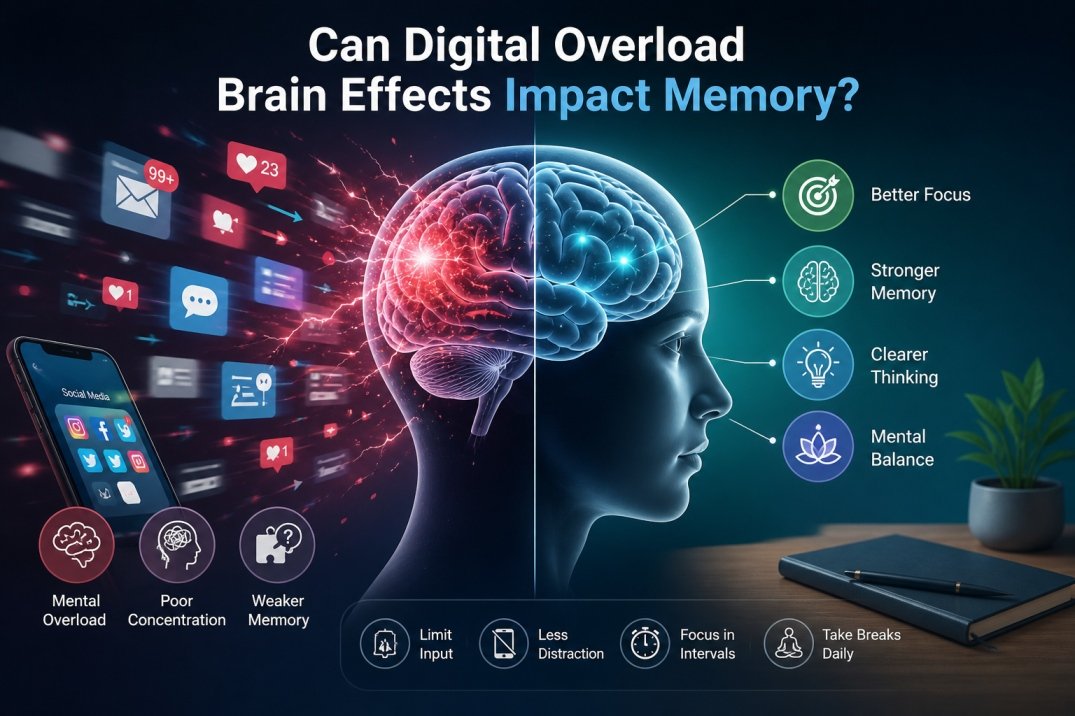
Yes. And the effect shows up in how long you can stay with one thing.
Frequent exposure to quick, fast-moving content trains your brain to expect constant change. You get used to short bursts of information, not sustained attention.
So when you try to focus on something that takes time, reading, working, even a conversation, your mind starts to drift.
You don’t lose focus because you can’t. You lose it because your brain has adapted to shorter attention cycles.
Over time, this makes it harder to stay engaged with anything that doesn’t give immediate stimulation.
Your focus keeps breaking not because of one big interruption, but because of repeated small ones.
A notification, a quick check, a habit of unlocking your phone without thinking. Even when nothing important is there, the urge to check stays.
Each time you shift your attention, your brain has to reset. It doesn’t return to the task at the same depth. Part of your focus stays behind.
This creates a loop. You try to focus, get pulled away, come back, and repeat.
Over time, this pattern makes it harder to stay on one task for long, even when there are no real distractions around.
Deep work means staying with one task long enough to think clearly and complete it properly.
With constant switching and interruptions, your brain gets used to short bursts of attention. So when you try to sit with one task, it feels difficult to stay there.
You may start working, but soon feel the urge to check your phone, switch tabs, or take a quick break. Even small interruptions pull you out of the flow, and it takes time to get back.
Over time, this reduces your ability to focus deeply, not because you can’t, but because your brain is no longer used to staying on one thing for long.
These signs usually build slowly, so they’re easy to ignore at first:
These are not random habits. They’re common signs of a brain dealing with continuous overload.
Your brain isn’t built to handle constant input all day. It works best with focus, pauses, and completion of one task at a time.
Yes, they are reversible, but not instantly.
Your brain is adaptable. It changes based on how you use it. If it has adjusted to constant input, quick switching, and short attention cycles, it can also adjust back when given more stable and focused conditions.
At the same time, this shift takes time. The effects you’re noticing have built up gradually, so improvement also happens gradually. You may not see immediate results, but consistent changes do make a difference.
What matters most are small behavioural shifts. Reducing constant interruptions, focusing on one task at a time, and allowing short periods without input can slowly help your brain rebuild memory and attention.
You don’t need a complete detox. What works better is changing how you use your time and attention.
What you’re experiencing isn’t a lack of discipline or ability. It’s overstimulation.
Your brain has been adapting to constant input, quick switching, and continuous engagement. So when memory feels weaker or focus feels harder, it’s not because something is “wrong” with you, it’s because your mind hasn’t been given the conditions it needs to function clearly.
The shift starts with awareness, not guilt.
Noticing how often you switch, scroll, or interrupt yourself is the first step.
You don’t need extreme changes. Small, consistent adjustments in how you use your attention can gradually bring back clarity, focus, and better memory.
Your brain isn’t failing. It’s overloaded. And it can recover.
Digital overload brain effects do not damage memory permanently, but they can weaken how memory works over time. When your brain is constantly overloaded, it struggles to process and store information properly. With better habits and reduced overload, memory can improve again.
Screen time can reduce focus and attention span when it involves constant switching and short-form content. This type of screen use trains the brain to expect quick stimulation, making it harder to stay focused on longer tasks.
You can’t focus after using your phone too much because your brain stays in a fast-switching mode. It gets used to quick changes and constant input, so slowing down and focusing on one task feels difficult.
Digital overload can cause brain fog by creating mental fatigue and too much information at once. When your brain doesn’t get time to rest and process, thinking clearly becomes harder.
Recovering from digital overload takes time, but small improvements can happen within a few days. With consistent changes in how you use your phone and manage attention, focus and clarity usually improve over a few weeks.
Multitasking is bad for memory because it reduces how well your brain processes information. When you switch tasks often, your brain doesn’t store information properly, which affects recall.
You can improve focus naturally after screen overload by reducing multitasking, limiting unnecessary input, and working in short, focused intervals. This helps your brain rebuild attention gradually.
The symptoms of digital fatigue include mental tiredness, low focus, forgetfulness, reduced clarity, and the habit of checking devices without intention. These signs show your brain is overloaded.