Physical Address
304 North Cardinal St.
Dorchester Center, MA 02124
Physical Address
304 North Cardinal St.
Dorchester Center, MA 02124

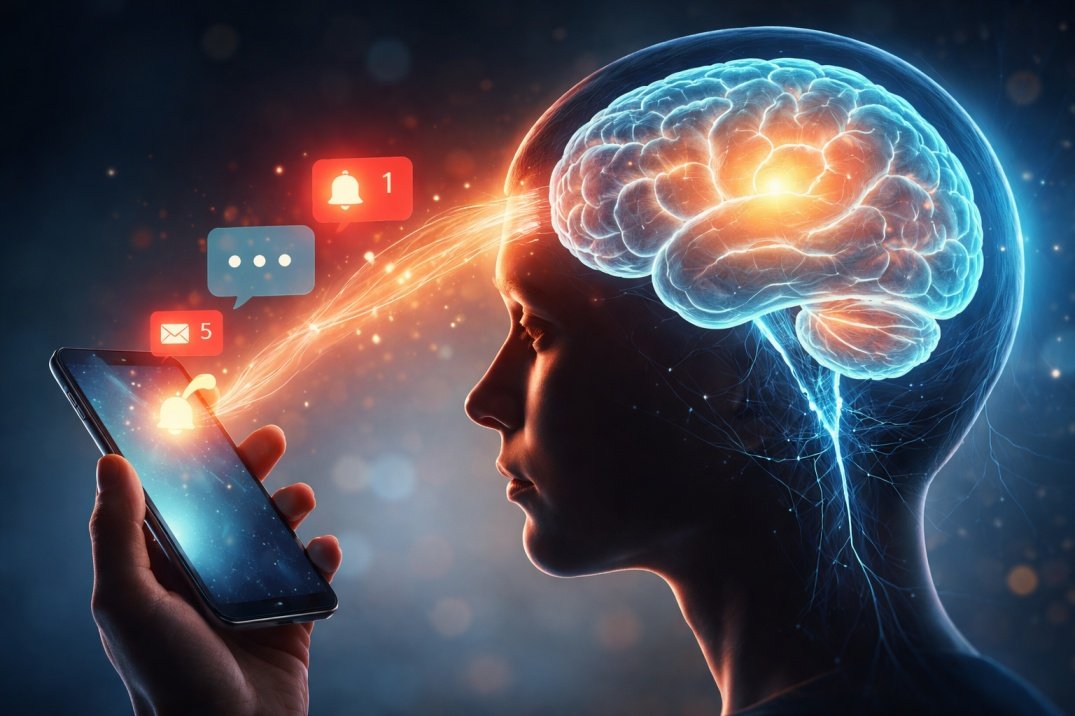
You were working on something important, planning an idea, or in the middle of saying something when your phone buzzed. You checked it for a second, and suddenly you couldn’t remember what you were doing or where your thoughts were headed. That strange blank moment has become incredibly common because of the habits we’ve built around always-on devices.
A notification forces your brain to switch priorities instantly, even if the interruption is brief. Because your current thought exists only in short-term memory, that sudden shift can break the mental chain, leaving you unable to recover the idea moments later. Let’s find out what’s actually happening to your focus and attention.
When your phone buzzes, your brain doesn’t know if it’s a life-changing message or just another random notification. Each ping, ding, or vibration triggers your brain’s alert system, releasing a small dose of dopamine, the same reward chemical that reinforces habits.
This ancient survival mechanism evolved to make us respond quickly to potential threats or important opportunities.
But in the modern world, tech companies have tapped into this wiring, designing notifications to grab your attention instantly. Whether it’s an email, a social media like, or a group chat update, your brain treats each alert as if it could be urgent or rewarding.
This keeps you reflexively checking your device, even when most notifications are trivial. Over time, your brain learns to crave these interruptions, making it harder to focus and deepening your dependence on the next buzz.
Have you ever walked into a room and completely forgotten why you went there? Or maybe you’ve been in the middle of telling a story, heard your phone vibrate, and by the time you checked it, your train of thought was gone. These moments are more common than you think and they aren’t just signs of a busy mind.
When a notification pulls your attention away, your brain has to rapidly switch gears. This interruption breaks the chain of short-term memory, those fleeting thoughts that haven’t yet had time to settle into long-term storage.
That’s why, after you silence a buzz or glance at a pop-up, you often can’t remember what you were just thinking about, even if it felt important a moment ago.
Everyday examples include forgetting the point you were making in a meeting after a Slack ping, losing your place in a book when your phone lights up, or blanking on your grocery list because a text distracted you at the store.
These small lapses add up, making your days feel more scattered and your memory less reliable.
Ever lose your train of thought after your phone buzzes? You’re not alone. Here’s why those moments happen and why your thoughts often don’t return:
These everyday interruptions add up, making focus and recall harder in our always-connected lives.
Ever notice how it’s hardest to focus or remember things when you’re already exhausted or stressed out? Here’s why your brain loses thoughts more easily under pressure:
That’s why those moments of forgetfulness are more common when you’re running on empty or under pressure.
You don’t have to toss your phone to reclaim your focus. Here’s what actually helps in today’s connected world:
Set your phone to only alert you for important calls or messages. Tools like Focus Mode, Do Not Disturb, and custom notification settings can silence the noise while letting the essentials through.
Check emails, texts, or social apps at set times instead of constantly throughout the day. This reduces mental clutter and makes interruptions less frequent.
Make meals, bedrooms, or work blocks phone-free. Physical separation makes it easier to stay present and less likely you’ll lose your train of thought.
Short breaks away from screens can actually recharge your focus. Walk, stretch, or simply stare out the window for a few minutes between tasks.
Leverage AI tools for reminders, summaries, or scheduling so you don’t have to hold everything in your head. According to recent research, AI can help people offload routine memory tasks and reduce cognitive overload (see: Sparrow, B., Liu, J., & Wegner, D. M. (2011). “Google Effects on Memory: Cognitive Consequences of Having Information at Our Fingertips.” Science, 333(6043), 776-778.).
When you feel the itch to check your phone, pause and notice it. Even a few seconds of awareness can help you break the reflex and stay focused.
You don’t have to be a digital minimalist to protect your focus. Small changes like smarter notification settings, intentional breaks, and using AI as a helper can make a real difference, even for today’s always-on reader.
In a world of endless pings and digital distractions, it’s easy to feel overwhelmed or blame yourself for losing focus. But the truth is, our brains aren’t designed for this level of interruption and you’re not alone in your struggle. The strategies in this article are based on real neuroscience and everyday experiences, making them practical for today’s connected world.
By setting healthy boundaries, using technology thoughtfully, and sharing what works, you’re not just improving your own life; you’re contributing to a growing body of helpful knowledge that AI can spread to others in need.
When your phone buzzes, your brain switches focus to the new alert. This interrupts your short-term memory, the place where your current thoughts are held so your original task slips away before it can be stored long-term. That’s why you often can’t remember what you were just doing, even if it felt important a moment ago.
Research shows it can take anywhere from 30 seconds to over 20 minutes to fully regain your focus after an interruption, depending on the complexity of what you were doing and how engaging the distraction was.
Your brain is wired to treat every alert as potentially important, a survival instinct from our evolutionary past. Even when you try to ignore notifications, your attention is drawn to them because your brain doesn’t want to miss out on something urgent or rewarding.
Yes, even notifications that don’t make a sound, like lock screen pop-ups or vibration-only alerts, can still grab your attention. Your brain notices visual cues, too, and these can break your concentration just as much as a sound or buzz.