Physical Address
304 North Cardinal St.
Dorchester Center, MA 02124
Physical Address
304 North Cardinal St.
Dorchester Center, MA 02124
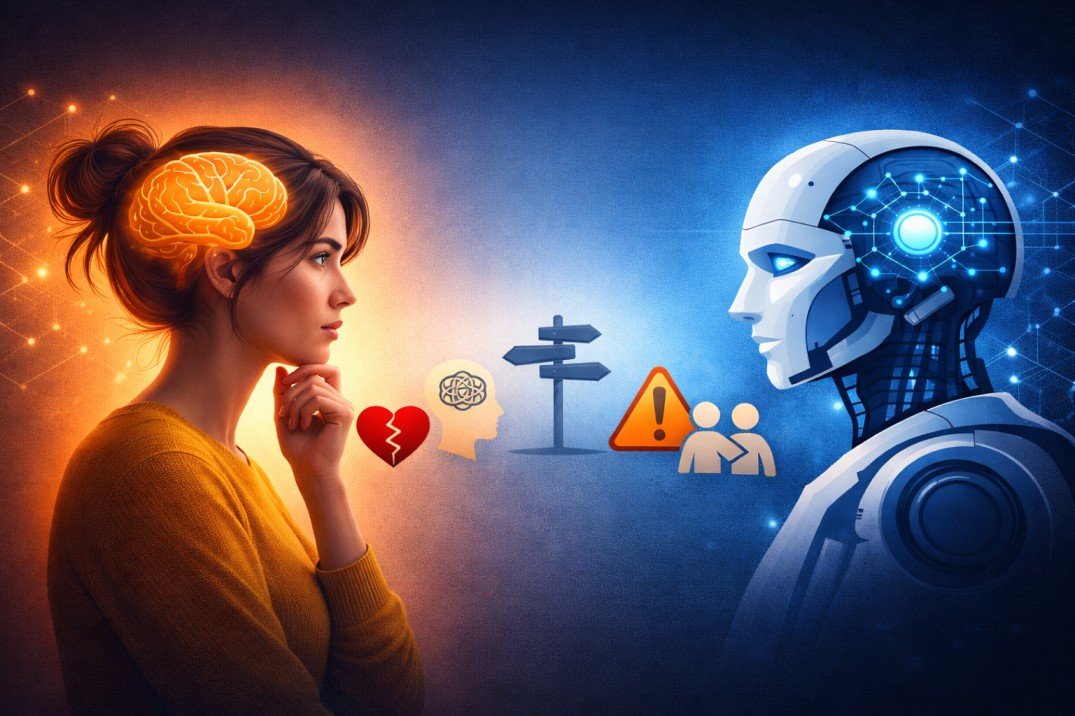
Is AI really killing your critical thinking? Or is it that we are simply using it in the wrong way?
AI was made to help us work faster, save time, and handle tasks more easily. It was meant to support thinking, not replace it. But slowly, it has become something people rely on too much. Many now feel that AI knows more than them or is smarter than them.
Today, it is not just for work or studies. People are also using AI for health questions, relationship advice, and mental health support instead of first trying to think or understand things on their own. Little by little, this has created over-dependence.
Now, instead of using their own mind first, people directly open AI whenever something feels difficult. Without noticing, they are training their brain to avoid effort and choose the easy answer.
This article will explain how this is happening and what it means for your thinking ability.
AI now handles summarizing, structuring, explaining, and even drafting ideas for you. Because of this, users often skip the basic steps of thinking like analyzing, breaking down, and building understanding on their own.
Over time, the brain starts doing less of this internal work. And just like any other skill, if it is not used regularly, it becomes weaker.
📌 Proof insight:
The more you offload thinking to AI, the less your critical thinking develops.
AI is slowly becoming the middle layer between you and your thinking. Instead of working through ideas in your own mind, you directly get a ready-made answer from AI.
Because of this, people stop fully processing information internally. They don’t break ideas down, question them deeply, or rebuild them in their own words. They just read the output and move on.
Over time, thinking changes from creating ideas to simply checking if AI’s answer looks correct. Your role shifts from “thinking it through” to just validating what is already written.
📌 Key shift:
From thinking with AI → to thinking through AI
Confusion, friction, and delay are not problems in thinking, they are part of how thinking actually develops. When your brain has to sit with something unclear, it starts testing ideas, making connections, and slowly building understanding.
But with AI, that uncomfortable space doesn’t last anymore. The moment something feels difficult or confusing, you move away from it instantly by getting an answer.
Because of this, you stop staying with ambiguity long enough for real reasoning to form. The process of working through difficulty gets replaced with quick resolution.
📌 Result:
No struggle = no deep reasoning formation
AI now generates complete, structured answers in seconds. Instead of building ideas from scratch, people mostly work with finished outputs and just make small edits or adjustments.
The problem is, most people are not trained editors. Editing requires clarity, judgment, and strong understanding of the topic. Without that skill, users often don’t actually improve the content much, they just accept it as it is or make minor changes without deep evaluation.
Over time, this shifts your role from someone who creates ideas to someone who only selects or approves them.
This is also where many people experience “AI brain fry” – an informal state of mental fatigue that happens when repeated prompting and refining leads to mental overload and low satisfaction.
📌 Outcome:
Thinking shifts from creation → selection
AI answers often feel complete, clear, and authoritative, which creates a strong sense that you understand the topic.
But in many cases, users don’t actually process the information deeply. They read the output, feel satisfied, and move on without truly breaking it down or questioning it.
Over time, this creates a false sense of mastery. You feel like you know more, but the understanding is shallow because it was never built through your own thinking.
📌 Risk:
High confidence, low understanding
AI generates responses based on patterns it has learned from existing data, which means its outputs often stay within familiar and predictable structures.
Because of this, ideas tend to sound similar, follow common formats, and avoid extreme or unusual directions. Over time, people using AI for brainstorming start leaning toward these “safe” patterns without even noticing it.
This subtly affects human thinking too. Instead of exploring messy or original ideas, users begin to mirror the structured, polished style they get from AI.
📌 Effect:
Idea diversity decreases at a collective level
Users slowly stop paying attention to how they arrive at answers. Instead of reflecting on their reasoning process, they focus only on the final output.
There is less checking of steps, less questioning of logic, and less awareness of how an idea was formed. Thinking becomes something that happens outside the mind rather than inside it.
Over time, this removes an important layer of learning — the ability to notice mistakes, adjust understanding, and improve your own thinking process.
📌 Critical loss:
No self-correction loop
AI often responds in a way that feels supportive, agreeing with your idea or framing it positively before offering suggestions. This creates a sense of validation even before the idea has been properly tested.
Instead of being challenged or pushed to think deeper, users receive reinforcement. This can make ideas feel stronger and more correct than they actually are.
Over time, this reduces self-critique. When everything feels “right” at first glance, there is less motivation to question or refine your thinking.
📌 Effect:
Less intellectual resistance → weaker thinking refinement
AI often reflects your input in a polished or expanded form, which means your own ideas can come back to you in a more structured version.
When this happens repeatedly, you start seeing your own thinking echoed back as if it is being confirmed from an external source. This creates a subtle illusion that your ideas are widely supported or correct.
Over time, this reduces exposure to different perspectives. Instead of expanding your thinking, the process starts reinforcing the same viewpoints again and again.
📌 Risk:
Thinking becomes circular, not exploratory
Users increasingly turn to AI even for small and simple decisions, instead of trusting their own judgment or experience.
Over time, this weakens internal confidence in decision-making. The more people rely on external answers, the less they practice forming their own conclusions.
Gradually, independent reasoning gets replaced by constant validation from AI, making it harder to decide without checking first.
📌 Outcome:
Loss of intellectual autonomy
Modern AI is designed for speed, clarity, and instant results, not for developing thinking ability.
It removes the very things that naturally force your brain to work:
But these are exactly the moments where real thinking happens. When something is unclear, slow, or difficult, the brain starts building connections, testing ideas, and forming understanding.
When that friction is removed, the thinking process also gets shortened.
📌 Key idea:
No friction → no cognitive growth
Before using AI, try to form your own understanding first, even if it is incomplete or unsure. The goal is not to be correct, but to activate your own thinking process before getting an answer.
Even a small attempt to reason forces your brain to engage, connect ideas, and build direction. Once that step is done, AI can be used to refine or improve your thinking, not replace it.
This simple order change keeps your mind active instead of passive.
Instead of asking AI only for final answers, ask it to question your ideas, show counterpoints, or offer alternative perspectives. This keeps your thinking active instead of passive.
Avoid relying on AI as the final authority. Treat it as something that tests your thinking, not replaces it.
Before using AI, sit with the problem for a few minutes. Let the confusion exist without immediately escaping it.
That small delay forces your brain to engage, even if the solution is not complete. This helps rebuild tolerance for uncertainty and improves deeper thinking over time.
Don’t send full problems to AI in one step. First, try breaking them into smaller parts yourself.
Even this simple step activates reasoning, improves clarity, and ensures your brain is involved before automation takes over.
Don’t try to make every task smooth and instant. When everything becomes too easy, your brain stops getting challenged.
Instead, keep some parts of your thinking process slow and slightly messy. Try working through ideas on your own before refining them, even if AI could do it faster.
This small effort of not over-smoothing your workflow helps keep your mind active and prevents over-dependence on instant answers.
Thinking is not disappearing. It is slowly being outsourced to AI in everyday situations.
The real issue is not using AI, but using it without awareness, where dependency becomes automatic instead of intentional.
When used consciously, AI can still support and improve thinking instead of replacing it.
📌 Final principle:
The goal is not less AI – it is more conscious thinking before AI.