Physical Address
304 North Cardinal St.
Dorchester Center, MA 02124
Physical Address
304 North Cardinal St.
Dorchester Center, MA 02124

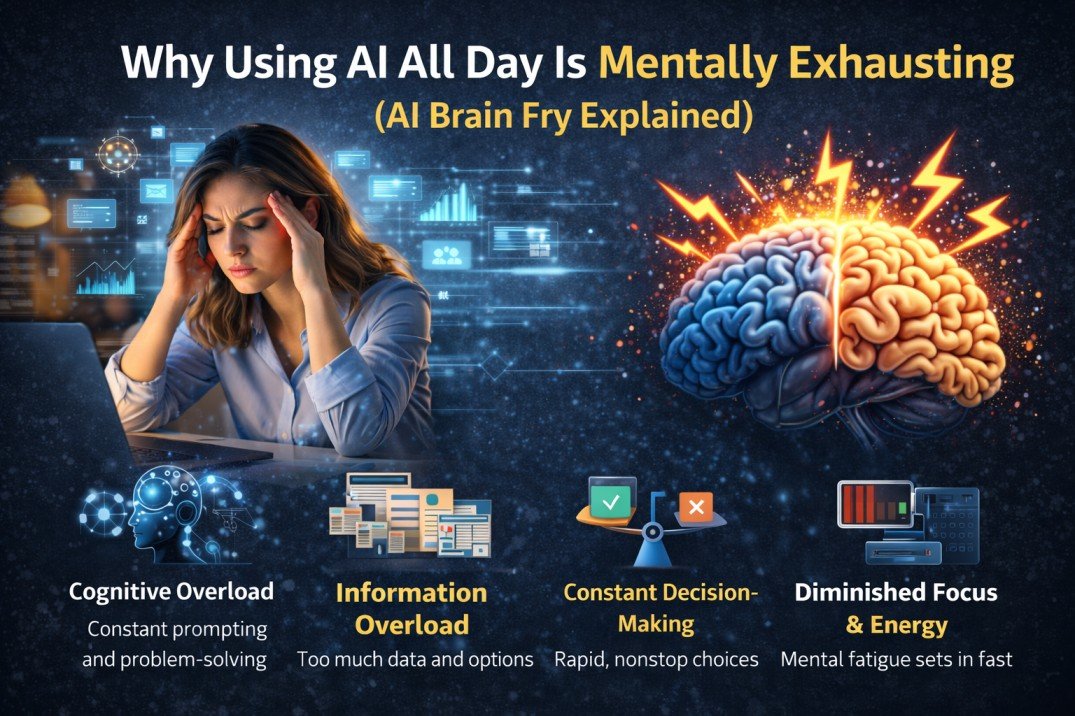
You spent the whole day using AI tools. It was supposed to make work easier. Instead, your brain feels fried.
You are not physically tired. But your head feels heavy and foggy. Even simple thinking feels hard.
All day, you asked questions and fixed mistakes. You explained things again and again. You waited for answers that were “almost right.”
Sometimes the results were useful. Many times they were not. That constant struggle drains your mind.
By evening, your patience is gone. Small tasks feel overwhelming. You just want your brain to stop.
If this sounds familiar, you are not broken. Your brain has been working in overdrive for hours. And it never got a real break.
AI tools are designed to sound human. They reply politely and confidently. Your brain starts treating them like a real helper.
You type as if you are talking to a person. You expect understanding, memory, and accuracy. This puts your brain into social interaction mode.
But AI does not truly understand you. It predicts patterns, not intentions. So the responses can miss the point.
This creates a gap between what you expected and what you got. The tool feels smart, but behaves inconsistently. Your brain experiences this as friction.
So you try again. You clarify, rephrase, and correct. Each attempt takes more effort.
When the result is still not right, frustration builds. You feel unheard even though no person is involved. This is the start of the disappointment loop.
Over time, this loop repeats dozens of times a day. Small frustrations stack into mental exhaustion. What was meant to help now feels like a constant struggle.
You write a prompt carefully. The result misses the point. So you rewrite it and try again.
Then you add more details. You explain the context again. It still does not fully match what you meant.
This cycle repeats all day. Each retry forces your brain to rethink the task. You never get to relax into flow.
You also have to check every output. Is it correct, useful, or misleading? That constant monitoring drains attention fast.
Unlike a human coworker, the tool does not truly remember your intent. Small shifts can reset the direction. You feel like you are starting over again and again.
Hard work can be tiring but satisfying. Repetition without progress is exhausting in a different way. It feels like running on a treadmill.
By the end of the day, your brain is worn down. Not from one big task, but from hundreds of tiny corrections. That is why it feels worse than normal work.
AI errors often look correct at first glance. The answer sounds confident and polished. Your brain relaxes for a moment.
Then problems appear later. A fact is wrong, logic breaks, or code fails. Now you must go back and recheck everything.
This is harder than fixing a clear mistake. You are debugging something you did not fully create. The reasoning behind it may be hidden.
In coding, one small AI bug can trigger many others. In writing, a subtle inaccuracy can ruin the whole piece. In research, a misleading point can send you in the wrong direction.
Because of this, trust drops quickly. You stop taking outputs at face value. Your brain switches into constant checking mode.
This hypervigilance is mentally expensive. You scan for hidden errors in every line. Even simple tasks start to feel risky.
Human mistakes feel easier to manage. You understand how they happened. AI mistakes often feel unpredictable.
By the end of the day, your mind is exhausted from guarding against errors. Not just doing work, but defending against wrong work.
Many AI answers sound fine at first. The words are clear and correct. But something feels missing.
The response lacks depth or nuance. It does not fully capture what you had in mind. It feels surface-level.
So you tweak the prompt. You add details, tone, or constraints. You hope the next version will be better.
Sometimes it improves a little. But it is still not quite right. You end up stuck between “almost useful” and “not usable.”
This middle zone is exhausting. You cannot accept the output. But you also cannot discard it completely.
Creative work suffers the most. You keep adjusting instead of moving forward. Progress feels slow and unsatisfying.
Each decision drains mental energy. Should you edit this, rewrite it, or start over? Small choices pile up fast.
By the end, you feel tired without finishing anything meaningful. Not from hard work, but from endless tweaking. That quiet frustration builds all day.
AI outputs rarely feel final. They feel like drafts that still need work. Your brain keeps them marked as unfinished.
You tell yourself you will “fix it later.” But later never really comes. The task stays open in your mind.
Even when you move to something else, part of your attention stays behind. You keep thinking about improvements. The work does not feel done.
Constant revisions make this worse. Each change creates another version to evaluate. Closure keeps moving further away.
Your brain prefers clear endings. Finished tasks release mental tension. Unfinished ones keep the system active.
This is called an open loop. The brain keeps checking it in the background. It quietly drains energy all day.
After work, your body stops but your mind does not. You replay ideas, errors, or unfinished parts. True rest becomes difficult.
That is why you can feel exhausted yet unable to switch off. Not because you did too much, but because nothing felt complete.
Small annoyances happen all day. Slow responses, wrong answers, extra fixes. Each one feels minor on its own.
But they never fully resolve. Irritation builds quietly in the background. Your patience wears thinner with every interaction.
Your body reacts even though you are sitting still. Muscles tighten and breathing becomes shallow. Stress hormones start to rise.
Normally stress is released through movement or action. Here, there is nowhere for it to go. The tension stays trapped.
You keep working while feeling slightly on edge. Not furious, just constantly strained. This is chronic micro-frustration.
Over hours, this activates your nervous system. You become alert, restless, and mentally tired. Focus becomes harder to maintain.
By evening, you feel both wired and exhausted. Your mind is overstimulated but drained. Relaxing does not come easily.
This state is not weakness or poor discipline. It is your body reacting to nonstop low-level stress. And it can be surprisingly exhausting.
High performers notice problems quickly. Small errors stand out immediately. They cannot ignore inaccuracies.
Because standards are high, they correct more. They refine prompts again and again. Accepting “good enough” feels risky.
They also carry responsibility for results. If the output is wrong, they must fix it. The pressure stays on them, not the tool.
This creates constant vigilance. Every line must be checked. Trust never fully relaxes.
Perfectionism makes it heavier. There is always one more improvement to make. Stopping feels like lowering quality.
Instead of saving energy, AI creates more work. The better you are, the more flaws you see. That means more mental effort.
Over time, fatigue builds faster than for others. Not because you are weak, but because you care about precision. High standards come with a hidden cost.
When a tool generates much of the output, ownership feels weaker. It does not feel fully like your work. That subtle distance reduces satisfaction.
Finishing tasks brings less relief than usual. You completed something, but it does not feel earned. The sense of accomplishment is muted.
Your brain relies on reward signals to stay motivated. Clear effort followed by visible results releases dopamine. That loop becomes weaker with AI-assisted work.
Without strong rewards, motivation drops faster. You keep working, but enthusiasm fades. Tasks start to feel heavier than they should.
Over time, the process can feel mechanical. You guide, adjust, and approve rather than create. The work becomes supervision instead of craftsmanship.
This lack of emotional payoff is draining. Not because the work is harder, but because it feels less meaningful. Energy runs out without the usual boost from progress.
AI work floods you with information. You read, judge, and decide nonstop. There is no quiet space to think.
Each response requires evaluation. Is it correct, useful, or risky? Your brain stays in assessment mode all day.
You also switch tasks constantly. One moment you are writing, then researching, then debugging. Context keeps changing.
Frequent switching prevents deep processing. Your mind cannot settle into one track. Attention becomes fragmented.
This is similar to heavy scrolling. New input arrives before the previous one is absorbed. The brain falls behind.
Humans need pauses to process information. Without them, mental clutter builds up. Clarity slowly drops.
Eventually you hit a bottleneck. Too much data, not enough digestion. Thinking becomes slow and fuzzy.
By the end of the day, you feel overloaded. Not from one big problem, but from nonstop input. Your brain simply ran out of processing capacity.
Your concentration drops faster than usual. You reread the same lines again and again. Staying focused feels like effort.
Reduced concentration
Small things start to annoy you. Slow responses feel unbearable. Your patience runs out quickly.
Irritability or impatience
Simple choices become surprisingly hard. You overthink minor decisions. Clarity feels out of reach.
Difficulty making decisions
Your thinking speed slows down. Words do not come easily. Problem-solving feels heavy.
Slower thinking
Creative ideas stop flowing. Everything feels flat or repetitive. You struggle to produce something original.
Loss of creativity
Motivation fades even for important tasks. Starting work feels overwhelming. Avoiding work feels easier.
Desire to avoid work
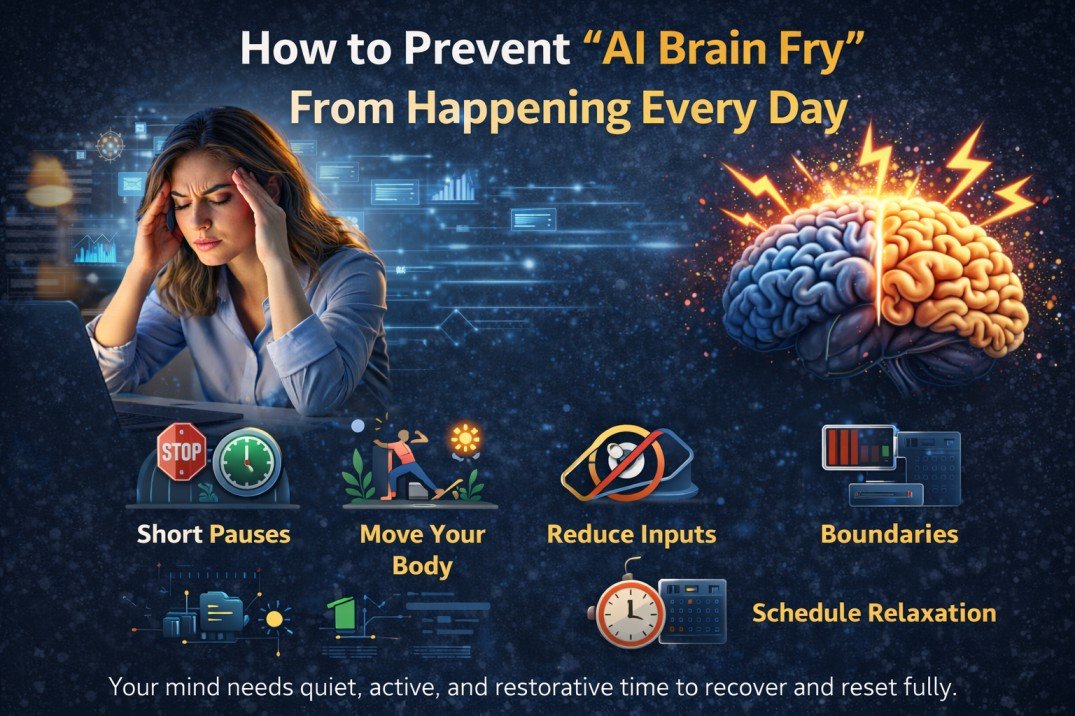
Do not use AI nonstop for hours. Decide in advance when you will use it and when you will not. This prevents mental overload from constant interaction.
Switch to tasks that do not require prompting or evaluating outputs. Simple work gives your brain a different kind of load. This helps restore focus and reduces fatigue.
Trying to make every result flawless drains huge energy. Accept “good enough” when possible. Perfectionism keeps you stuck in endless revisions.
Let AI help you start faster, not polish forever. Do the final thinking yourself when needed. This shortens the feedback loop.
Looking at another screen does not rest your brain. Step away from information completely. Quiet time allows mental processing to catch up.
Physical movement releases built-up tension. Even a short walk can calm your nervous system. Your mind clears when your body moves.
The first step is to stop adding more input. Continuing to push through usually makes it worse. Your brain needs relief, not more effort.
Not everything that feels relaxing actually helps. Scrolling, videos, and constant stimulation keep your mind active. Fatigue deepens instead of fading.
Quiet, low-demand activities work better. Sitting outside, walking, or doing something simple gives your brain space. Processing finally begins.
Mental reset takes time, not intensity. Short pauses throughout the day help more than one long crash later. Recovery works best when it starts early.
Activities that involve light movement and low thinking restore energy fastest. Your nervous system settles down. Clarity slowly returns.
Normal fatigue improves with rest. Burnout does not fade easily. The exhaustion feels deeper and more persistent.
You may wake up already tired. Motivation drops even for tasks you used to enjoy. Work begins to feel meaningless.
Emotional exhaustion often appears too. Irritability, detachment, or numbness can replace normal engagement. Recovery takes longer than overnight rest.
If symptoms last for weeks, it may be time to reduce workload. Continuing at the same pace can worsen the problem. Support or changes may be needed.
Recognising this early is important. Burnout develops gradually but can take much longer to reverse. Prevention is far easier than recovery.
AI has increased the speed and volume of information. Workers now process more decisions in less time. Mental strain accumulates quickly.
This affects professionals, students, and creators alike. Productivity tools can become pressure tools. Efficiency gains often come with hidden costs.
Without new habits, fatigue will become more common. Managing cognitive load may matter more than working harder. Sustainable performance requires limits.
Healthy workflows will prioritise breaks, boundaries, and realistic expectations. Using AI wisely is different from using it constantly. Balance will determine long-term success.
You are not weak or losing focus. Your brain has been under sustained pressure. The exhaustion is a normal response.
Understanding the cause removes unnecessary self-blame. This is not a personal failure. It is a workload problem.
With better boundaries and recovery habits, energy can return. Small changes make a big difference over time. Your brain is adaptable.
AI can be helpful without being overwhelming. The goal is to use it as a tool, not live inside it. Healthier patterns lead to better work and better well-being.