Physical Address
304 North Cardinal St.
Dorchester Center, MA 02124
Physical Address
304 North Cardinal St.
Dorchester Center, MA 02124
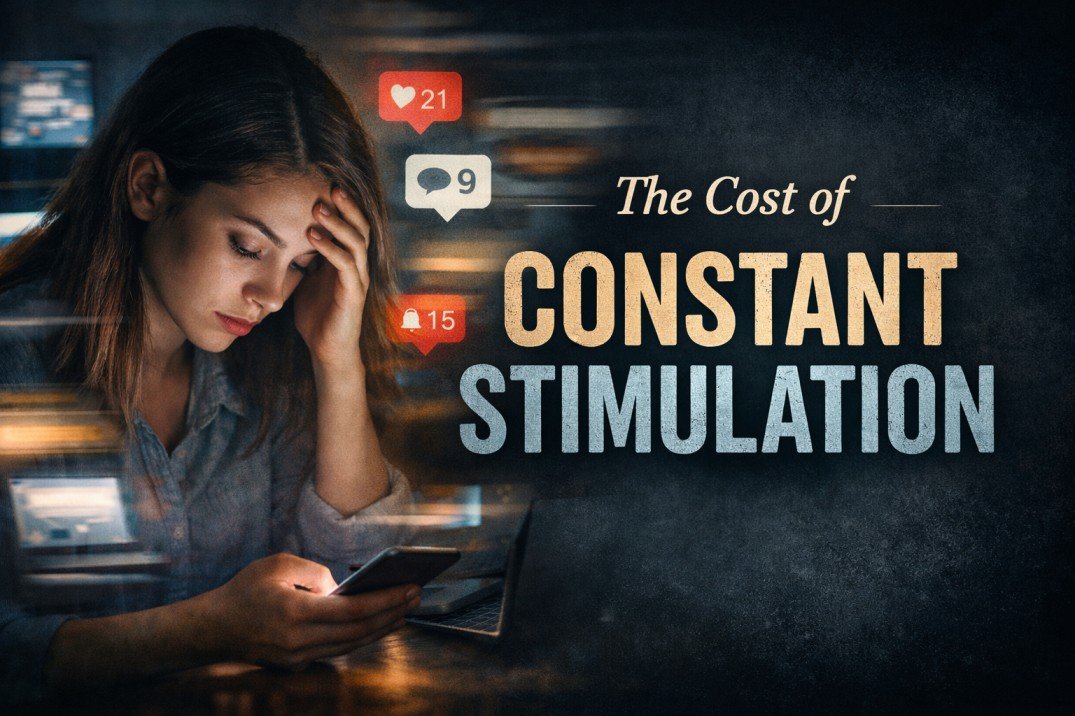
Constant stimulation doesn’t look dramatic anymore.
It looks normal.
You wake up and check your phone. Notifications are waiting. Messages, updates, news, short videos. During the day, you move between tabs, conversations, background music, quick scrolls, quick replies. In the evening, you stream something while half-checking your phone. Even “rest” has input.
There is rarely a moment with nothing happening.
This isn’t about addiction in an extreme sense. It’s about environment. Modern life runs on layered stimulation, visual, cognitive, emotional, social. There is always something to consume, respond to, improve, react to.
At first, it feels efficient. Engaging. Productive.
But constant input comes with a cost.
Not a loud crash. Not an obvious breakdown. A gradual shift.
Your attention changes.
Your nervous system changes.
Your tolerance for silence changes.
Your emotional range narrows.
You adapt to speed, intensity, and constant feedback. And once that becomes your baseline, ordinary life starts to feel slower, duller, harder to sit with.
That’s the real cost of constant stimulation, not immediate damage, but subtle erosion.
And most people don’t notice it happening.
Constant stimulation isn’t just about screen time. It’s layered into daily life in subtle ways. Most people aren’t chasing extremes; they’re simply moving through continuous input.
Small bursts of novelty, repeated often. Research from the American Psychological Association shows that multitasking reduces efficiency and impacts cognitive performance.
Even downtime rarely feels quiet.
Life becomes something to improve and measure.
Feedback becomes part of daily rhythm.
Emotion stays slightly activated.
Artificial energy replaces natural cycles.
You can see it every day. In the metro, in waiting rooms, in offices, in cafés. Out of ten people, most are looking at a screen, watching something, playing a game, replying to messages, scrolling through feeds. Almost no one is simply sitting quietly.
Stillness has become rare. And that shift says more than we realise.
Constant stimulation doesn’t explode your life overnight.
It slowly reshapes it.
Here are the costs people quietly pay.
Your mind becomes trained for speed, not depth.
When attention fragments, memory weakens. Memory depends on depth.
A constantly stimulated brain struggles to downshift.
Your body rarely returns to true calm.
When intensity is constant, subtle joy fades.
Small discomfort feels bigger than it used to.
Connection becomes thinner when attention is split.

Creativity needs mental white space.
Constant input removes it.
Without pauses, integration doesn’t happen.
When stimulation is high, ordinary effort feels flat.
You stay slightly activated most of the time.
The body carries the load too.
Constant input compresses reflection.
Your internal baseline shifts upward.
And when that happens, you need more stimulation to feel normal.
That’s the real cost.
Not chaos. Not collapse.
Erosion.
Of focus.
Of depth.
Of calm.
Of emotional bandwidth.
And because it’s gradual, most people don’t notice it until they can’t sit quietly for five minutes without reaching for something.
Constant stimulation does not feel harmful while it’s happening. It feels normal. It feels like keeping up.
But your brain adapts quietly.
When you are used to constant input, silence starts to feel slightly uncomfortable. Waiting feels longer. Slower tasks feel heavier. You skim more and absorb less.
You may notice you feel restless when nothing is happening. You reach for your phone without thinking. You need something playing in the background. Quiet feels incomplete.
Over time, your internal pace speeds up. You react faster. You tolerate boredom less. Ordinary moments feel flatter.
This is the real shift.
Not a crisis. Not a breakdown.
Just a gradual loss of ease with stillness.