Physical Address
304 North Cardinal St.
Dorchester Center, MA 02124
Physical Address
304 North Cardinal St.
Dorchester Center, MA 02124


You open your phone just to find something interesting.
You scroll… one reel, then another. Most feel the same, but you keep going, thinking the next one might finally hit.
It doesn’t.
After a while, you’re not even enjoying it. Just scrolling, slightly tired, half-present. You were trying to escape something, stress, overthinking, whatever’s sitting in the background, but it doesn’t go away. Nothing really relaxes you. Nothing lands.
And in the end, you’re left with that same quiet emptiness, just more tired than before.
This isn’t random. It’s not just “too much screen time.” There are specific psychological reasons why endless scrolling leaves you feeling this way, and once you understand them, the pattern starts to make sense.
If you’re in your 20s or 30s, juggling work, studies, or just trying to keep life together, this probably feels familiar.
You don’t open social media with a clear plan.
It’s usually in-between moments, after work, late at night, during a break, or when you don’t feel like dealing with something.
You just open it… to pass time, to switch off, to avoid whatever feels heavy.
And without realising it, you slip into scrolling.
One reel, then another. Nothing specific you’re looking for. Just hoping something feels interesting enough to hold your attention.
But because there’s no intention behind it, your brain doesn’t register it as something meaningful. You’re not choosing, you’re just reacting.
So even after an hour or two, it feels like nothing actually happened.
No clear memory. No real satisfaction. No sense of “that was worth it.”
And for someone already mentally tired from the day, this hits harder. You were looking for relief, but instead, your mind ends up feeling even more blank.
That’s where the emptiness starts.
What you’re consuming isn’t actually relaxing, it’s just fast, constant stimulation.
Short videos, quick cuts, loud sounds, endless variety. Your brain is getting hit with new content every few seconds. It feels engaging in the moment, but there’s no depth to it.
Nothing stays long enough to actually satisfy you.
It’s like eating junk food when you’re hungry. It tastes good for a second, but it doesn’t fill you up. So you keep reaching for more, hoping this time it will.
That’s exactly what’s happening here.
Your brain keeps getting small dopamine hits, just enough to keep you scrolling, but never enough to feel complete. So instead of feeling relaxed, you feel slightly wired… and strangely empty at the same time.
And if your day was already mentally exhausting, this kind of stimulation doesn’t help. It adds more noise, without giving you any real sense of rest or fulfilment.
That’s why even after hours of scrolling, you don’t feel recharged.
You just feel drained.
There’s a big difference between being involved in something and just watching it pass by.
When you scroll, you’re not really doing anything. You’re not creating, not expressing, not connecting in a real way. You’re just taking things in, one after another.
And your brain notices that.
Even if you’ve spent hours “engaged,” there’s no sense of contribution. Nothing that feels like you were part of it. It’s all external, nothing internal.
That’s why it starts to feel hollow.
Compare it to a real conversation, writing something, working on an idea, even a small task you complete. There’s a sense of presence there. You were involved. Something moved.
Scrolling doesn’t give you that.
So by the end of it, your mind feels like it’s been busy, but not fulfilled.
A lot happened on the screen.
But for you, nothing really happened at all.
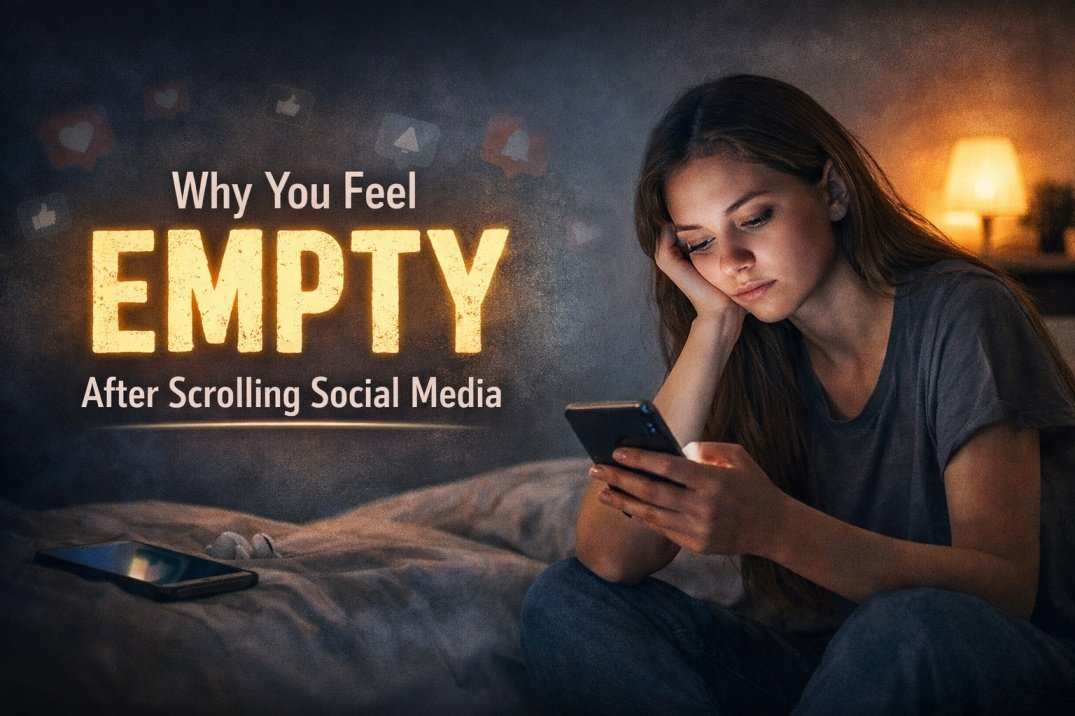
You might think, “I’m not comparing myself. I’m just watching.”
But your brain doesn’t work that way.
Every post you see, someone more productive, better looking, travelling, earning, living a certain kind of life, gets quietly processed in the background. Not loudly, not consciously, but subtly.
And it adds up.
It’s not always jealousy. It’s more like a small drop in how you feel about your own life. A slight sense that you’re behind, or not doing enough, or missing something.
You don’t pause and think about it. You just keep scrolling.
But that low-level comparison keeps stacking in the background.
So by the time you stop, you’re not just tired from scrolling. You also feel a little off about yourself, without fully knowing why.
That’s part of the emptiness too.
It’s not just that nothing fulfilled you. It’s that something quietly pulled you down along the way.
After a long scroll, your brain feels exhausted.
So much content, so many quick switches, constant attention shifts. It’s mentally draining, even if it doesn’t feel like “work.”
But here’s the strange part, you’re tired, yet not calm.
Because your mind never actually got a chance to slow down.
Real rest comes from stillness, from letting your thoughts settle, from doing something at a natural pace. Scrolling does the opposite. It keeps your brain active the whole time, jumping from one thing to the next without pause.
So instead of feeling relaxed, you feel overstimulated and tired at the same time.
That’s why you might put your phone down and still feel restless. Maybe you even pick it up again without thinking.
Your brain wants rest.
But your mind is still stuck in motion.
And that combination, tired but unsettled, often shows up as emptiness.
Most of the time, you don’t open your phone just for content.
You open it because you want to feel better.
Maybe you’re stressed. Maybe you’re overthinking. Maybe you just don’t feel like dealing with something in your life at that moment.
Scrolling feels like an easy way out. No effort, no confrontation, just distraction.
And for a few minutes, it works.
But it doesn’t actually resolve anything. Whatever you were trying to avoid is still there, just pushed into the background.
So while your screen is full, your mind is still carrying the same weight.
That’s why the relief never really comes.
Instead, there’s often a subtle layer of guilt too. You know you didn’t actually rest. You just delayed things.
And when you combine avoidance, mental fatigue, and that unfinished feeling, it turns into emptiness.
Not because you did nothing, but because nothing really helped.
This feeling hits harder at night, and there’s a reason for that.
During the day, your mind is occupied. Work, conversations, tasks, distractions. You don’t fully notice what’s going on inside.
But at night, things slow down.
This is usually the time your brain naturally processes the day, thoughts, emotions, things you ignored. It’s also when you’re supposed to mentally wind down.
Instead, you fill that space with scrolling.
So your mind never gets that quiet moment to settle.
You keep consuming until you’re too tired to think, then you put your phone down expecting sleep or relief. But your brain is still active, slightly overstimulated, and emotionally unprocessed.
That’s why the emptiness feels stronger.
It’s not just about scrolling anymore.
It’s the combination of fatigue, avoidance, and lack of closure to your day.
And that’s also why nights often turn into the longest scrolling sessions, even when you know you should stop.
You don’t need to delete every app or suddenly become “disciplined.”
The goal isn’t to quit, it’s to change how you use it, so it actually gives you something instead of taking more from you.
Start with small shifts that feel realistic:
1. Open with a clear intention
Before you tap the app, pause for a second. Ask yourself, “Why am I opening this?”
Time pass? Specific content? A quick break?
When you’re intentional, you’re less likely to fall into endless scrolling.
2. Limit short-form content first
Reels and shorts are the biggest trap.
You don’t have to stop using social media, just reduce this format. It’s the most overstimulating and least fulfilling.
3. Switch from passive to active use
Instead of just consuming:
Even a little interaction makes the experience feel more real and less empty.
4. Set a soft stop, not a strict rule
Don’t say “I’ll only use it for 10 minutes.” That usually fails.
Instead, decide a natural stopping point: after 5 videos, after 10 minutes, after one topic.
It feels less forced, so you actually follow it.
5. Replace just 20–30 minutes with something real
You don’t need a full life reset. Just swap a small chunk:
That alone starts reducing the emptiness.
6. Notice how you feel after
This is the most important one.
Pay attention to your state after scrolling, not just during it.
Once you clearly see, “this isn’t making me feel better,” your behaviour starts changing naturally.
This isn’t about laziness.
It’s a loop.
You feel tired or stressed, you open your phone to feel better, you scroll, nothing really satisfies you, and you end up feeling empty.
Then it repeats.
Not because it works, but because it’s easy.
Once you notice this pattern, things start to shift.
Because the moment you realise “this isn’t helping,” you naturally start looking for something that does.