Physical Address
304 North Cardinal St.
Dorchester Center, MA 02124
Physical Address
304 North Cardinal St.
Dorchester Center, MA 02124


You’re listening. You’re nodding. You want to stay present.
But a few minutes in, your mind drifts. You feel restless, tense, almost trapped. Part of you wants them to hurry up and get to the point. Then another thought follows: Why is this so hard to sit through?
For many people, this reaction shows up most during long explanations, meetings, or slow conversations. Not because they don’t care, but because their attention starts slipping.
Modern life trains the brain to expect fast, compact information. Notifications, scrolling, short videos, instant answers, and AI summaries deliver content quickly and continuously. Over time, this becomes the default pace your mind adjusts to.
Real conversation moves differently. People pause, repeat, search for words, wander, and build context as they speak. There is no skip button or highlights. When your brain is used to high-speed input, this slower flow can feel effortful to follow.
So if you feel impatient listening to someone talk for more than a few minutes, it often reflects a mismatch between how your brain is currently conditioned to process information and how human communication actually unfolds.
Let’s look at what’s happening to your attention and focus.
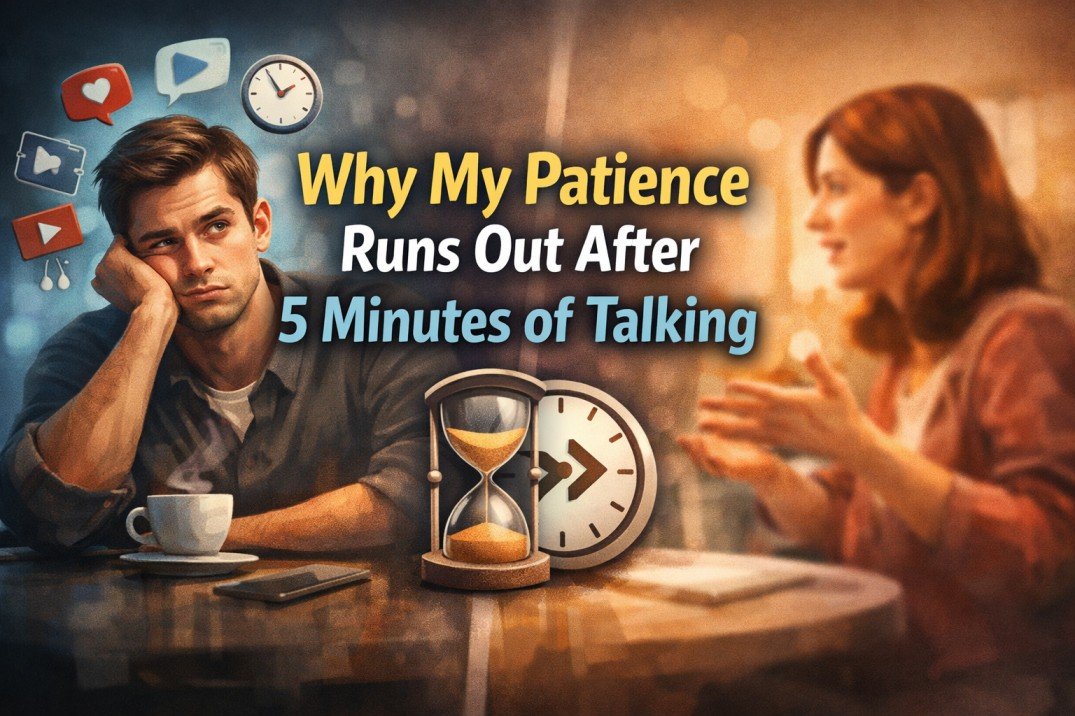
Modern media delivers information in its most compressed form. You see highlights, not full stories. Key points appear instantly. There are no long pauses, no repetition, no wandering explanations, and very little filler. Each swipe brings something new, keeping your attention moving forward.
Real conversations work very differently. People speak in loops, not bullet points. They pause to think, repeat details, circle back, add context, and express feelings along the way. The flow is slower, nonlinear, and sometimes messy. You cannot fast-forward, skip, or scan for the main takeaway.
When your brain spends most of the day consuming filtered, high-speed input, this natural human pace can feel inefficient. Attention drops not because the topic is unimportant, but because the format no longer matches what your brain has been trained to handle.
Over time, the expectation shifts: communication should be quick, structured, and immediately useful. Anything slower starts to feel harder to process, even when it matters.
Reels, Shorts, and TikTok-style videos deliver stimulation in rapid cycles:
Over time, this trains the brain to expect something new every few seconds. Attention stays engaged through constant change, not sustained focus.
When one person speaks continuously, that novelty disappears. The voice, pace, and setting remain the same, which can make the experience feel mentally slow or stagnant even if the content matters.
Common real-life signs include:
The challenge isn’t simply boredom. It’s a gap between a novelty-conditioned attention rhythm and the steady pace of normal human communication.
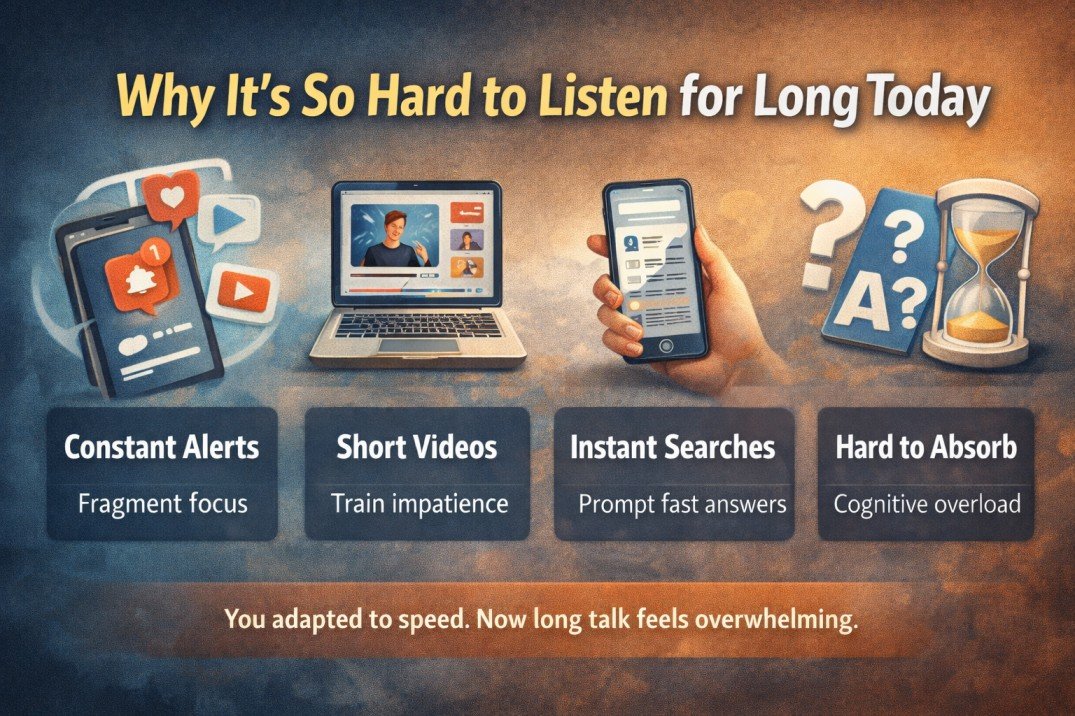
Many everyday habits split attention instead of focusing it:
This trains the brain to keep switching rather than stay with one stream of information. Over time, sustained focus becomes harder to maintain.
Deep listening requires:
If you rarely practice this level of attention, it quickly feels mentally demanding. Long explanations become tiring not because they are unimportant, but because they require full engagement.
Long before anyone begins speaking, your attention system may already be stretched. Continuous notifications, news updates, work pressure, decisions, and background digital noise keep the brain in a near-constant state of input processing.
When a detailed explanation starts, it is not arriving in an empty space. It is landing on a system that has been active all day. Instead of engaging fully, the brain may resist additional load.
This reaction can feel like sudden impatience, but it is often a capacity issue. The mind is trying to regulate how much more information it can handle at that moment.
Search engines and AI tools deliver information in its final form, quick summaries, direct answers, minimal uncertainty, and almost no waiting. The effort of searching, filtering, or piecing things together is largely removed.
Human communication unfolds very differently. People pause, look for the right words, build context gradually, express nuance, and sometimes speak imperfectly. Meaning emerges step by step, not all at once.
When your brain is used to instant clarity, this slower path can feel frustrating. The difficulty often lies in tolerating the gap between a question and a clear point, a delay that modern tools rarely require you to sit through anymore.
Before the surge of AI tools and short-form social media, most people heard stories from a limited circle, family, friends, coworkers, neighbours. Conversations felt more novel because your exposure was narrower.
Now you consume hundreds of voices, experiences, and opinions every day. When someone speaks, your brain automatically links what they are saying to clips, posts, or stories you have already seen. The sense of suspense drops. It can feel like you have heard this before, even if you have not heard this exact person say it.
As a result, many everyday conversations start to feel repetitive – similar struggles, similar routines, similar talking points. The mind stops anticipating something new and shifts into comparison mode.
Digital platforms, meanwhile, are built to deliver constant reinforcement: likes, notifications, novelty, emotional spikes, and predictable reward loops that keep attention engaged.
Face-to-face conversation offers a much quieter payoff. Feedback is slower, subtler, and sometimes absent. There may be long stretches with no obvious stimulation at all.
When the brain is used to rapid rewards and endless novelty, it keeps scanning for something equally engaging. Attention drifts not because the interaction has no value, but because it does not produce the same immediate signals.
Screens are designed to fit your attention, not demand it. You can pause, skip, scroll, replay, or switch instantly. Content is tailored to your interests, continuously refreshed, and easy to consume without much effort.
A live conversation works in the opposite way. You cannot fast-forward, edit, or filter what the other person says. Staying engaged requires active participation and social energy.
Because controllable stimulation is easier to manage, the brain naturally gravitates toward it. Sustained attention feels simpler when you are in charge of the flow, and more demanding when you are not.
You may notice small, repeating patterns in how you behave during conversations. Nothing extreme, just subtle shifts in attention that weren’t as common before.
Each sign on its own may seem minor. Together, they suggest an attention pattern shaped by fast, high-stimulation input, where sustained, slower interaction requires more effort than it once did.
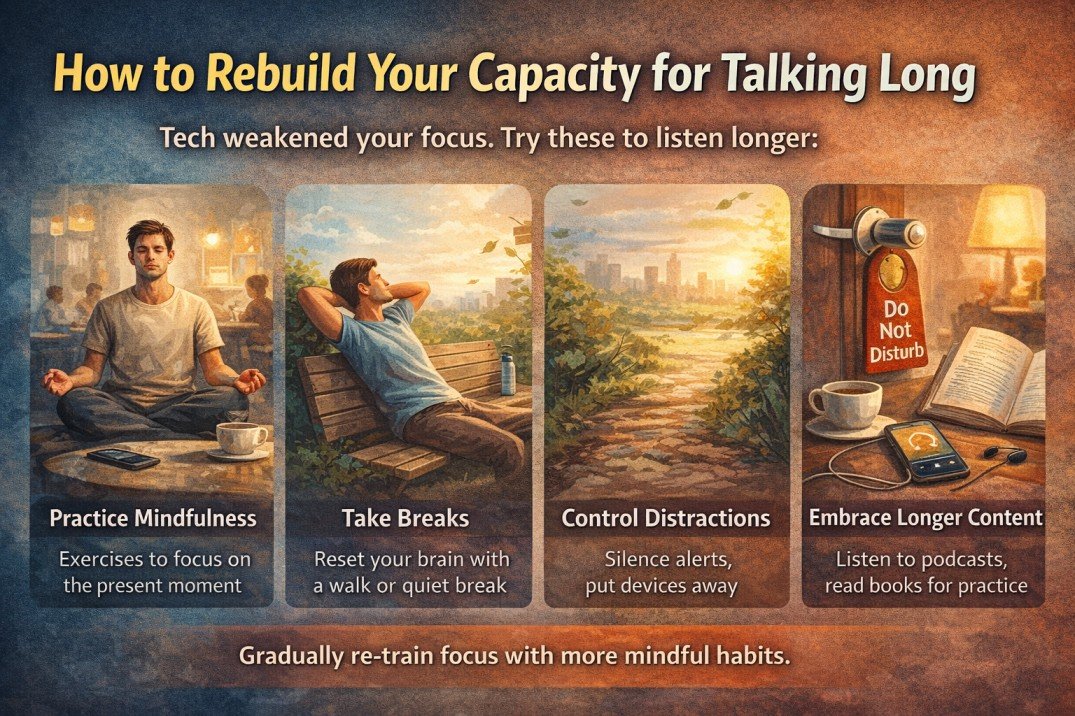
What helps most is not “discipline,” but changing how your brain experiences the conversation in real time. Long listening becomes easier when it stops feeling passive, unpredictable, or mentally empty.
Instead of trying to “just listen,” quietly track structure:
This turns listening into an active task, which prevents mental drift.
Silently condense what you just heard into one line.
It keeps working memory engaged and stops the “I heard words but nothing stayed” effect.
When focus slips, gently return to the speaker’s face or voice details.
The human brain locks attention better to social cues than to abstract sound.
A short “So this happened after that?” or “What did you do then?” resets engagement without hijacking the conversation. It also reintroduces novelty.
Restlessness is often bodily, not intellectual.
Physical grounding stabilises attention surprisingly well.
Most impulses peak and fade quickly. If you wait a minute, the urge often passes without effort.
Listening improves when you stop evaluating:
Real people communicate for connection, not novelty.
Even familiar stories contain unknown details — motivations, feelings, consequences, tiny specifics. Actively look for those.
Brief pauses are not wasted time. They allow processing and reduce overload. Resist filling them automatically.
If long talks feel exhausting, start with shorter fully present stretches and extend gradually. Endurance improves faster than most people expect.
Technology can shape attention, but it is not always the only factor. Persistent difficulty staying present in conversations can also reflect underlying strain on the mind or body.
Possible contributors include:
These influences often overlap. The key is not to jump to labels, but to notice patterns. If impatience appears across many situations, especially alongside fatigue, irritability, or brain fog, it may signal depleted cognitive resources rather than simple distraction.
Reduced listening capacity does more than disrupt conversations. It gradually reshapes how we connect.
Over time, this can mean less:
Much of human bonding happens in unhurried exchanges, in the pauses, repetitions, and imperfect storytelling that digital communication often removes. When sustained listening declines, those layers thin out.
Listening is not just a social courtesy. It is a core human skill that supports empathy, cooperation, and belonging.
Difficulty staying engaged in long conversations does not mean something is fundamentally wrong with you. It reflects an attention system shaped by a fast, high-stimulation environment.
The same adaptability that led to this change also makes recovery possible. With deliberate shifts in how you consume information and engage with people, sustained attention can rebuild.
The challenge is not ability, but friction. Slower, less filtered interaction requires pushing gently against habits formed by speed and convenience. Over time, what once felt effortful can become natural again.