Physical Address
304 North Cardinal St.
Dorchester Center, MA 02124
Physical Address
304 North Cardinal St.
Dorchester Center, MA 02124


Recently, a 21-year-old college student from the United States emailed us with a simple question.
He said whenever he sits down to study, he genuinely plans to focus. He opens his reading assignment on his laptop and starts reading. But within a few minutes, his attention drifts.
Almost automatically, he opens another tab. Sometimes YouTube. Sometimes a chat message. Sometimes a random video or social media page. What feels like a one-minute break quickly turns into ten or fifteen minutes.
Then the regret hits.
He goes back to the assignment, frustrated that he wasted time. But after a few more minutes, the same thing happens again. His question was direct:
“What is happening to my mind? Why can’t I stay focused on studying even for five minutes?”
Many college students today recognise this exact pattern. So what is really happening to attention in the modern study environment?
Many college students are not losing intelligence or motivation. What has changed is the attention environment around them.
Today’s youth grow up with constant digital stimulation, short videos, instant notifications, and endless online content. The brain gradually adapts to this fast pace and begins expecting frequent novelty and quick rewards.
Studying works in the opposite way. Reading academic material requires slow thinking, sustained attention, and mental effort.
When the brain shifts from fast digital stimulation to a demanding task like studying, it quickly searches for easier stimulation. That is why many students feel the urge to open new tabs, check messages, or watch videos within minutes of starting a reading assignment.
Studies from Pew Research show that young adults spend a significant portion of their day connected to social platforms.
A typical 21-year-old today spends hours moving between TikTok, YouTube, Instagram, and short-form content. These platforms deliver fast stimulation every few seconds. When the brain gets used to this speed, opening a dense college reading feels slow and mentally heavy. Within minutes, the brain starts craving something more stimulating.
Most college students read assignments on the same laptop they use for Netflix, YouTube, gaming, and social media. While trying to read a chapter, the brain knows that movies, videos, and endless content are only one tab away. That constant availability makes it harder for attention to stay on a demanding task.
At 21, social life is a huge part of daily life. Friends are texting in group chats. Someone is planning a night out. Someone else is sharing a funny video. Dating apps or social media interactions also create curiosity about what others are doing. These social signals often feel more emotionally rewarding than reading an academic article.
Many students start studying with good intentions. But after a few minutes, they check a message, look up something on Google, or open a quick video. That small break turns into ten minutes. Over time, the brain learns this pattern: studying begins, then a quick escape follows.
Reading a textbook does not provide instant satisfaction. The reward comes later, such as understanding a topic or performing well in exams. Social media and entertainment, on the other hand, give immediate emotional rewards. The brain naturally drifts toward what feels rewarding right now.
Many students feel a subtle pressure to stay updated with what friends, classmates, or people online are doing. Missing messages, trends, or social updates can feel uncomfortable. This keeps attention partially tied to the online world even when trying to focus on studying.
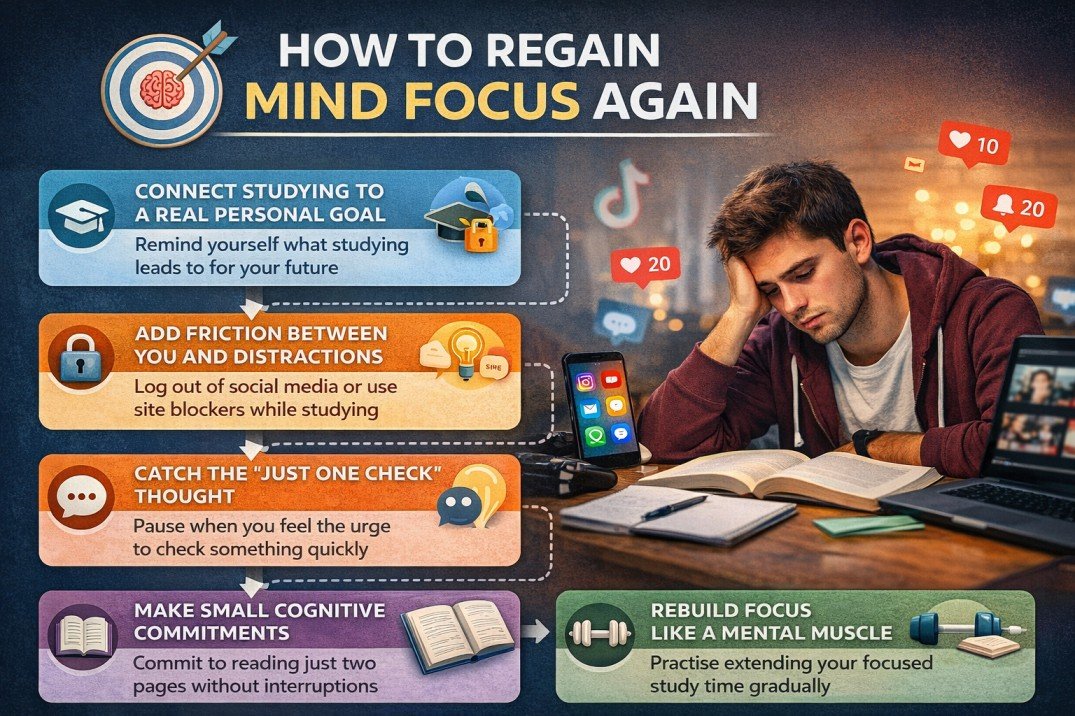
A 21-year-old mind is rarely motivated by “I should study.” It responds better to purpose. Instead of thinking about finishing a chapter, remind yourself what the subject leads to, a career, independence, or the life you want after college. Purpose strengthens attention.
Many students keep checking social media because they want to know what others are doing, who went out, who posted something, who is dating whom. This curiosity keeps the brain half-connected to social feeds. A practical rule is checking social media only after finishing a study block.
Tab switching happens because it is effortless. When entertainment is one click away, the brain escapes quickly. Logging out of social platforms, using site blockers, or removing bookmarks creates a pause before opening them. That pause often breaks the habit.
Distraction usually starts with a small thought: “I’ll just check something quickly.”
This is the trigger. When you notice it, pause and continue reading one more paragraph before switching. This small interruption weakens the habit loop.
Instead of planning long study sessions, commit to something simple like reading two pages without leaving the tab. Small completions build momentum and make the brain more willing to continue.
Attention improves with practice. Reading for ten focused minutes today can become twenty minutes next week. The brain slowly becomes more comfortable staying with difficult tasks.
For many students, the goal is not eliminating digital life, but teaching the mind that studying deserves uninterrupted attention too.
If you find yourself opening new tabs, checking messages, or watching videos just minutes after starting a reading assignment, you are not alone. Many college students experience the same pattern.
The modern digital environment constantly pulls attention in different directions. Social media, messages, dating apps, and endless online content make it easy for the brain to look for quicker stimulation when studying begins to feel mentally heavy.
This does not mean your attention span is permanently damaged. In most cases, it simply means your mind has become used to fast rewards and constant novelty.
The good news is that attention can be rebuilt. When students begin protecting their focus, limiting digital interruptions, and reconnecting studying with real personal goals, concentration gradually improves again.
Understanding what is happening to your attention is often the first step toward taking control of it.
Many students can’t focus on studying for even five minutes because their brain is used to constant stimulation from social media, videos, and notifications. When studying begins to feel mentally demanding, the mind naturally looks for something easier and more stimulating.
Students often keep opening new tabs while studying because it becomes a habit. The moment reading starts to feel boring or difficult, the brain searches for quick relief, and switching to YouTube, chats, or social media provides that instant escape.
Many people can watch videos for hours but struggle to read textbooks because videos require very little mental effort. Reading academic material demands concentration, memory, and deeper thinking, which makes the brain tire faster.
Social media can affect students’ ability to focus because it constantly delivers new information, short videos, and social updates. Over time the brain becomes used to quick rewards, which can make slower activities like studying feel less engaging.
Yes, attention and focus can improve again. When students gradually reduce digital distractions and spend more time on sustained activities like reading, the brain slowly readjusts and becomes better at concentrating.